Creative Health in Practice
What the work looks like from the other side of the conversation — and who's seen it.
Cambridge City Council's Sheltered Housing Herald featured the Ditchburn Place project in their Winter 2025 edition, under "Staying Active Together." Teresa Hurrell, Independent Living Supervisor, supported the work from the start and arranged for it to be written up across the council's Independent Living Service.
Staying Active Together
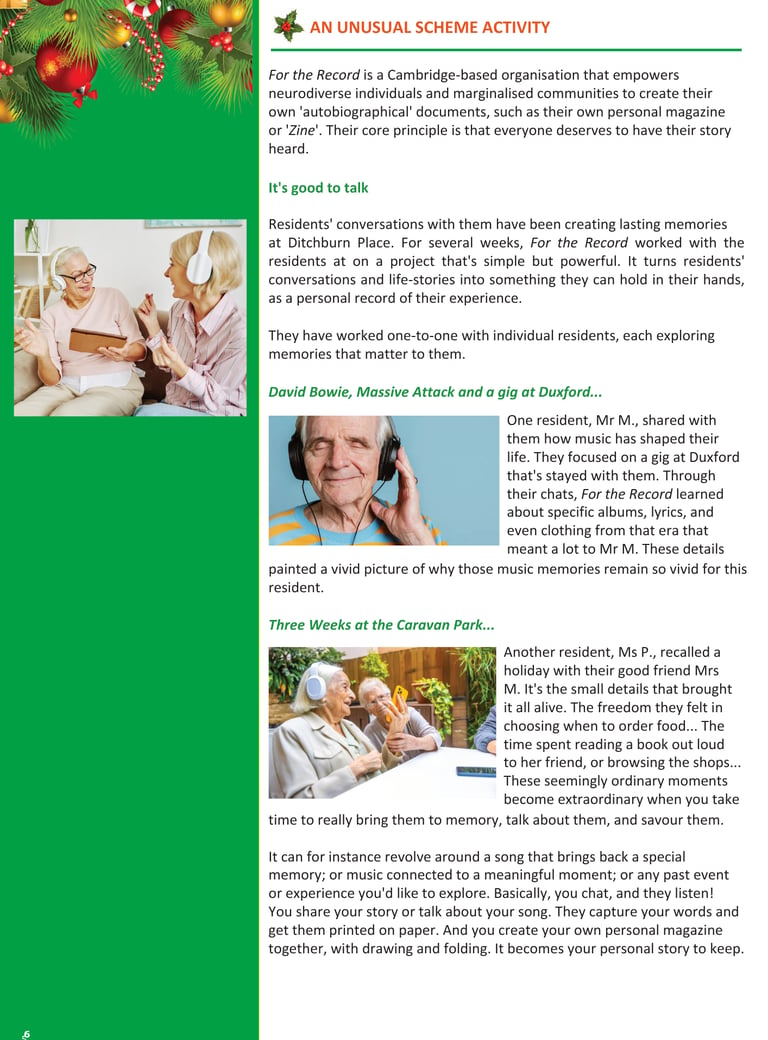
For several weeks, For the Record worked with the residents on a project that's simple but powerful. It turns residents' conversations and life-stories into something they can hold in their hands, as a personal record of their experience.
On what matters most
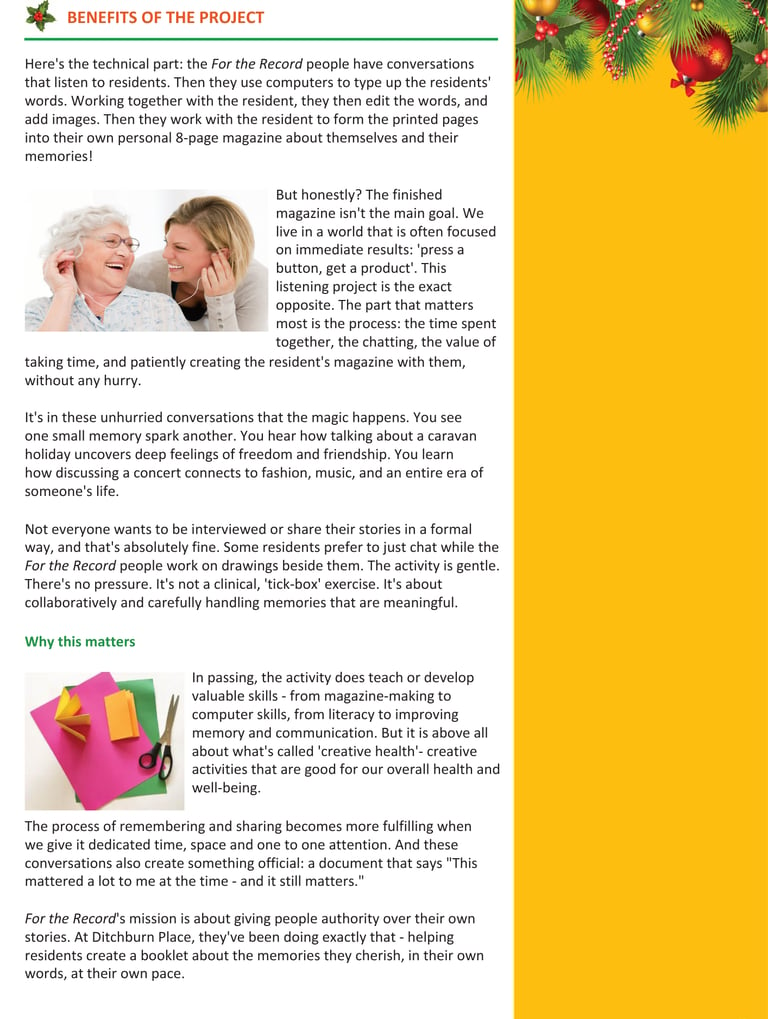
The finished magazine isn't the main goal. The part that matters most is the process: the time spent together, the chatting, the value of taking time, and patiently creating the resident's magazine with them, without any hurry.
On what happens in practice
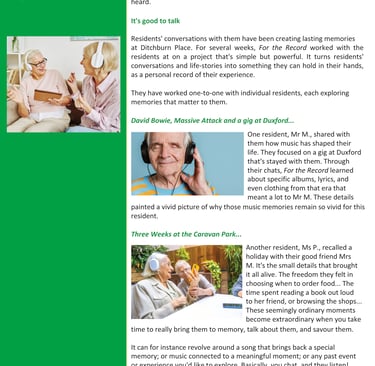
It's in these unhurried conversations that the magic happens. You see one small memory spark another. You hear how talking about a caravan holiday uncovers deep feelings of freedom and friendship. You learn how discussing a concert connects to fashion, music, and an entire era of someone's life.
Sheltered Housing Herald, Winter 2025 — Cambridge City Council Independent Living Service.

Sheltered Housing Herald, Winter 2025 · Cambridge City Council
Resident Feedback · collected by Teresa · names are pseudonyms
Anne
Enjoyed the approach David took in explaining the project.
He was engaging and I felt listened to. Enjoyed drawing and made to feel confident in my ability. A lot of fun, allowed me time to reminisce about the good times I had.
Would recommend the project to others.
Lisa
Unsure about this at the beginning. After a few sessions
I felt that I could share my thoughts and memories — not something I'd reflected on before or felt comfortable to do.
Listening to other people's stories helped me to talk about my own.
Safe space.
Marvin
Didn't know what to expect.
David explained very well. Found it easy to talk about my interests and experience. Felt listened to, not talked at.
Went very well — looking forward to the result. Allowed time to reflect.
How the sessions work
Equal conversation between two people. No one talks down to anyone else. We listen, draw, review what we've heard, and work out the next steps together. In this setting it sometimes took a month before someone joined in. Memories aren't produced on the spot. The act of being there, drawing, gives each person the room to choose to take part.
The activity is gentle. There's no pressure. Some residents prefer to chat while I draw beside them. Others want the whole process — editing words, choosing images, folding the pages. When someone's away at an appointment, the dynamic of the group shifts the conversation, and that's part of it too.
The conversations take shape as text and storyboards, which open up further conversations. One led to Aswad playing live at the Corn Exchange. When the text and the coloured drawings come together, they make something official — a record that says: this conversation happened, it has become an object, and these memories still matter.
This way of working lines up with the Creative Health Quality Framework — person-centred, collaborative, and realistic about what unhurried creative work with older adults can do
07754016940
Contacts
For The Record CIC · Company No. 16630605 · 19
We take time to talk out loud and work through it together.